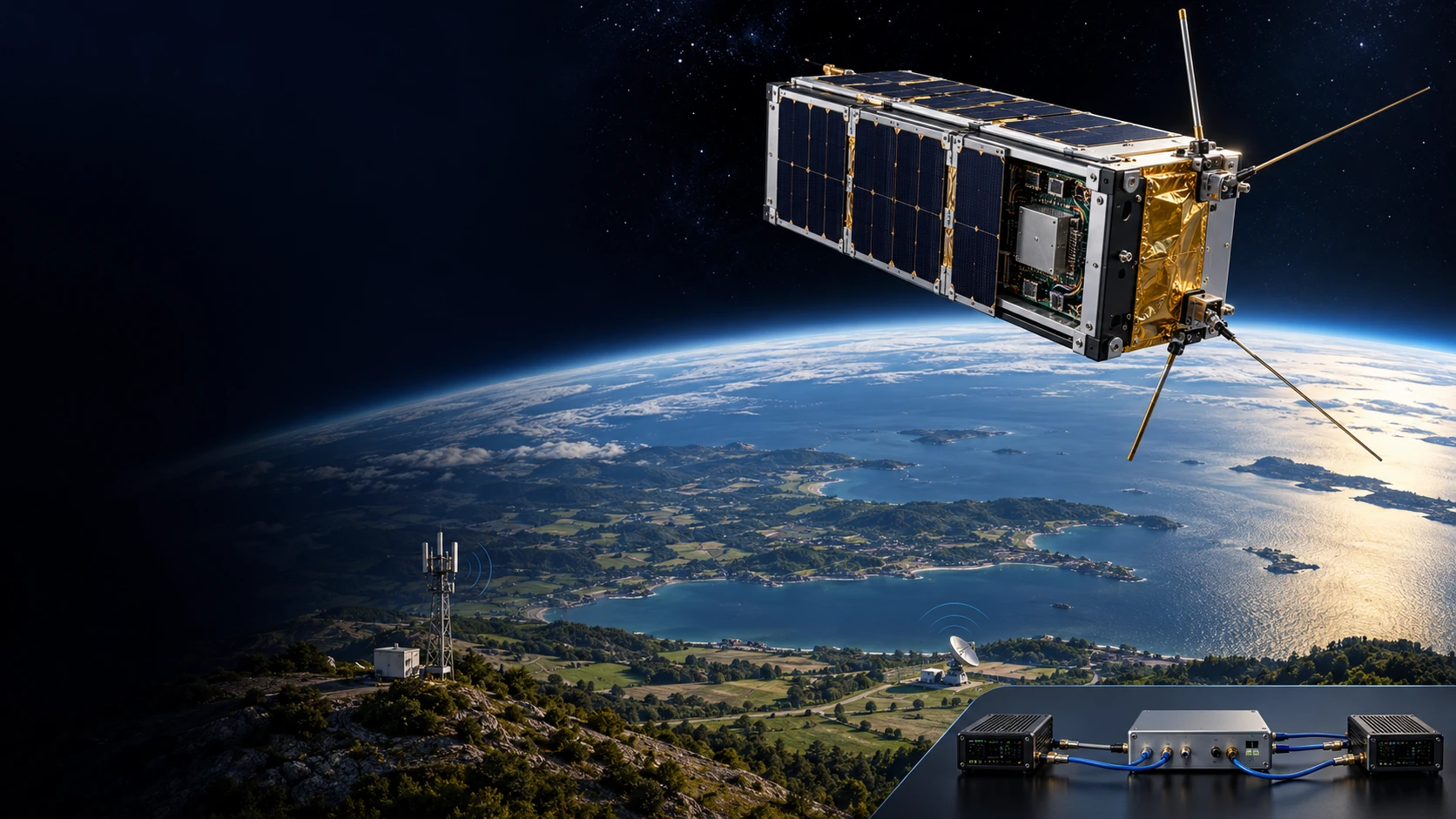
A satellite-borne 5G user terminal and conducted ground-evaluation concept.
Project focus
5G Nanosatellite develops a satellite-borne 5G terminal and the ground infrastructure it communicates with. The mission concept places an OpenAirInterface-based user terminal on an RFSoC platform inside a compact CubeSat, communicating with terrestrial base stations. Ground evaluation prepares the radio and protocol implementation for changing satellite-link conditions.
Testing challenge
What the evaluation needs to reveal.
Motion changes propagation time, frequency offset and available signal margin together. The satellite terminal and ground base station must manage access and useful traffic under those conditions. A conducted test separates the programmed link case from endpoint configuration before a future orbital demonstration.
Emulator contribution
Conducted satellite-link evaluation.
ELARA emulates the satellite link in the conducted ground setup between an OpenAirInterface base station and user equipment. The reported setup uses software-defined radios at both endpoints. This lets the team examine access and traffic under programmed conditions while the mission hardware and network implementation are developed.
Conducted ground evaluation / Suggested method
Three comparisons. One decision per run.
Suggested engineering practice, not reported 5G Nanosatellite results.
Explore the diagram ↗Mission concept above; conducted ground-evaluation roles below. ELARA supplies the RF path between the selected OAI/SDR endpoints. Ground evaluation and orbital demonstration remain separate stages.
Declare the selected endpoint builds, traffic, both RF directions and reference planes. The UE, gNB and core supply the network behavior; assistance and compensation remain part of that configuration. Keep their settings and update policy fixed across a comparison, and count each represented path contribution once.
Choose acceptance criteria from your system requirement. ELARA supplies supported RF conditions; the endpoints and instruments provide the observations.
A starting sequence for a compatible conducted setup
Comparison
Set up or change
Observe
Decision it supports
01 / Establish a baseline
Use the declared starting RF case; retain endpoint settings and offered traffic.
Network/session state and valid data delivery over a defined window.
Is the baseline usable for the planned comparison?
02 / Vary timing or frequency
Change one supported delay or Doppler factor initially; hold other declared inputs constant.
Acquisition/tracking, network events and useful data, with the applied RF condition verified.
Does the candidate setting meet the stated criterion under this case?
03 / Vary signal level
Change the supported level case; hold timing/frequency, traffic and receiver settings constant. Calibrate the receive reference plane for a margin claim.
Receiver quality and valid traffic; retain the applied level and measurement method.
Which tested levels meet the stated service criterion?
Combine delay and Doppler in a physically justified trajectory when needed. Independent sweeps do not by themselves represent an orbit. Align RF, network and receiver records using a justified clock relationship before reporting cross-record timing.
Interpret the response
A connection can remain active while useful data delivery fails. Record both against the declared criterion. Event correlation alone does not identify the cause.
Dated project context and source
In its 16 October 2025 update, Altice Labs reports that a functional 5G UE prototype equipped with a camera streamed real-time video to an internet-connected ground computer during a ground demonstration on 8 April 2025. This is a reported ground-prototype result; the account does not identify the emulator used.
Ground evaluation and a future mission are separate stages.
The selected OAI/SDR conducted test chain is distinct from spacecraft hardware and the planned orbital demonstration. This method introduces no new project result or flight qualification.
Optional editable evaluation records
Use a Test Brief for the setup, condition, criterion and evidence references, with a run table for observations. The optional archive contains constructed teaching records, separate from this project's evidence.