LuxWave — Emulate. Evaluate. De-risk.
SnT-funded projectHistorical institutional testbed

5G-SpaceLab

Space communications and control in one testbed

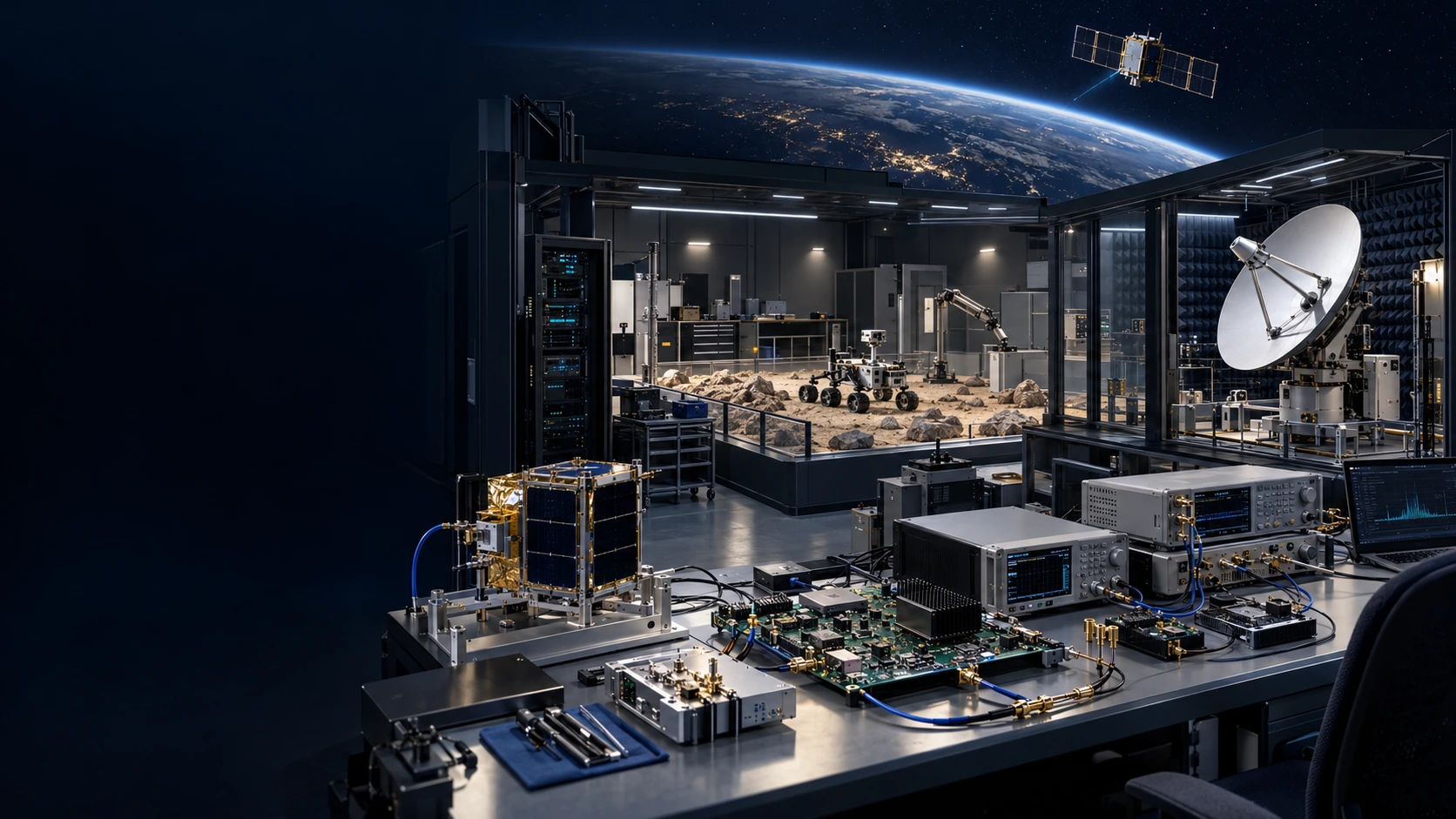
Conceptual institutional testbed combining radio and FPGA electronics, a representative spacecraft payload and indoor lunar-rover control context.
An institutional communications and rover-control testbed concept.
Project focus

5G-SpaceLab brought together SnT's satellite communications, spacecraft design and robotics laboratories. The platform connected mission scenarios with representative radios, satellite payloads and control experiments, allowing space-link behavior to be examined in an institutional testbed. Its research context includes Earth-orbiting communications and remote-control scenarios.

Testing challenge

What the evaluation
needs to reveal.

A space mission couples communications with the system that consumes commands and telemetry. Orbital geometry informs channel conditions, while the representative payload or controller supplies the operational observations. Evaluation links those inputs without treating a recovered radio link as proof of a successful control task.

Institutional testbed

An institutional channel-emulation testbed.

The published testbed architecture includes FPGA channel emulation between software-defined radio components. Mission scenarios are translated into channel conditions such as delay and Doppler for laboratory evaluation. This provides institutional context for SnT's channel-emulation research and its connection to spacecraft and control work.

Evaluation focusConditions. Observations. Engineering questions.A way to frame the evaluation.
ConditionObservationEngineering question
Mission-derived delay/Doppler profilesRadio synchronisation and telemetry recordsDoes the laboratory channel case correspond to the intended mission geometry?
Programmed link conditions around a representative payloadPayload/receiver traffic and stateHow does the communications implementation respond within the complete testbed?
Communications conditions alongside a control scenarioCommand/telemetry and controller observationsWhat happens to the control task when the communications path changes?

Partners and funding

SnT project funding, September 2020–September 2022.

Project roles

University of Luxembourg / SnT
Institutional host and project funding.
SIGCOM, SPASYS and SpaceR
Collaborating research groups.
Project sources