LuxWave — Emulate. Evaluate. De-risk.
EU-funded projectCompleted project; initial ELARA contribution

ETHER

Handheld access and terrestrial-to-satellite handover

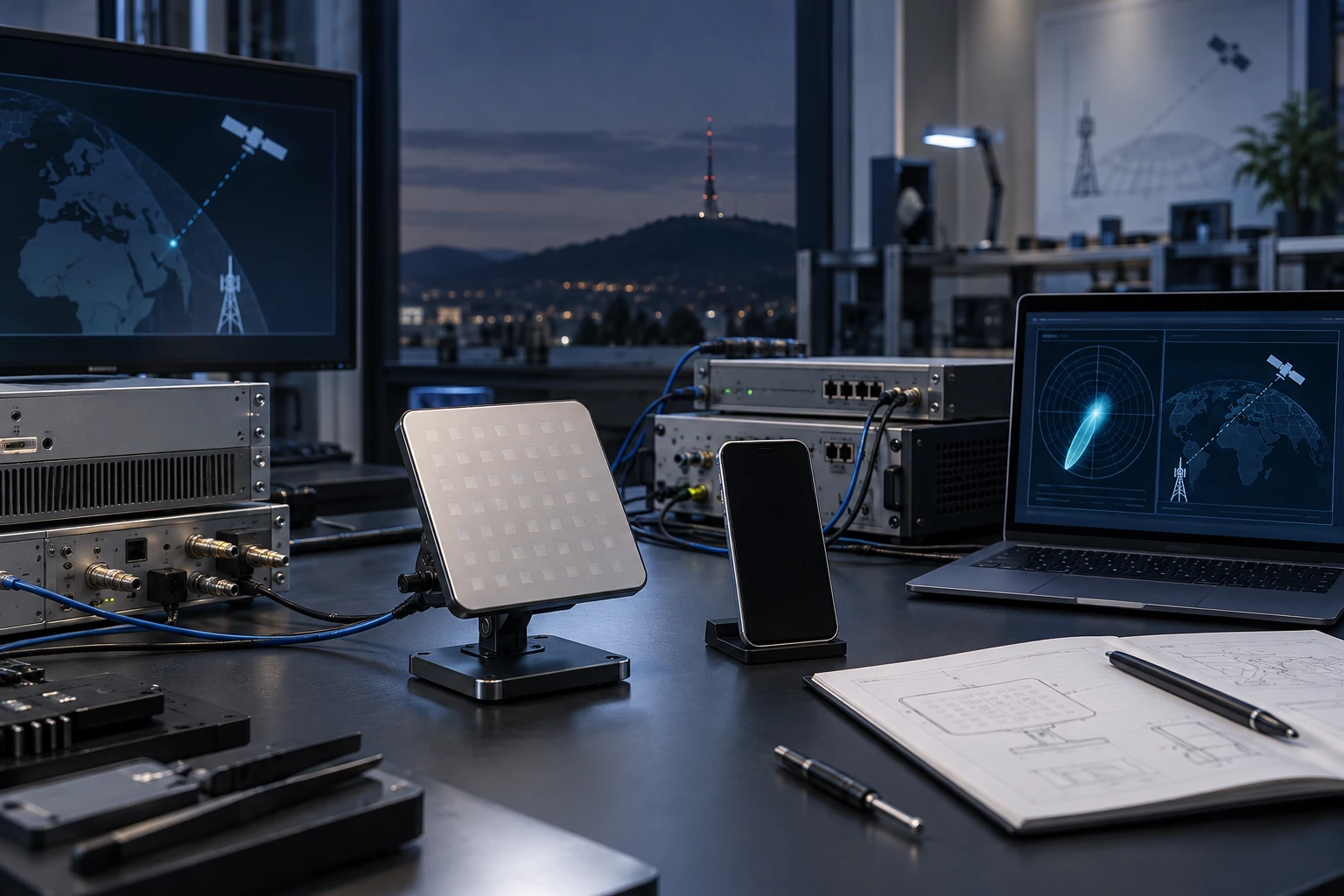
Conceptual laboratory handover scene with a handheld-scale flat antenna prototype, terrestrial and emulated satellite radio paths, and generic network equipment.
A laboratory concept for handheld antenna research and terrestrial-to-satellite handover.
Project focus

ETHER researched integrated terrestrial, aerial and satellite networks. Its handheld-access use case combines a prototype electronically steerable antenna with radio and network adaptations for transitions between terrestrial and satellite access. The consortium reported a hardware-in-the-loop handover demonstration at its March 2026 final showcase.

Testing challenge

What the evaluation
needs to reveal.

Handover has to coordinate the radio path, network state and useful service. The published laboratory setup couples a terrestrial access path and an emulated satellite path to the user equipment. Defined channel cases allow synchronisation, access-change events and session continuity to be examined together.

Emulator contribution

Preparing the handover test environment.

ELARA supported the initial handover experiments and preparation of the test environment for partner research. Its contribution provided controllable satellite-link conditions around the radio setup. The role described here concerns those initial tests and the evaluation environment.

Evaluation focusConditions. Observations. Engineering questions.A way to frame the evaluation.
ConditionObservationEngineering question
Satellite-link variation alongside the separately configured terrestrial accessUE/network access-change eventsWhen and how does the implemented handover occur?
Delay/Doppler cases around the satellite radio pathSynchronisation and timing-compensation recordsCan the radio implementation maintain the state needed for the transition?
Traffic during and after the access changeApplication/session timestamps and delivery recordsWhat happens to useful service through the handover?
Research context / A closer look

Distinguish the environment from the final demonstration.

ETHER’s consortium reported a performed hardware-in-the-loop demonstration of terrestrial-to-satellite handover at its March 2026 final showcase. The system-level question is how radio conditions, network transition and useful service behave together.

ELARA supported initial handover experiments and preparation of the test environment for partner research. That contribution is distinct from the consortium’s later final-showcase result. The public report alone does not establish the final emulator build, ELARA’s share of an observed improvement or a LuxWave performance metric.

For a useful continuity test, align the intended radio change with actual network events and application records. A change in serving access, a reconnected bearer and a continuing useful session are related observations with different meanings.

Two separate evidence scopes: ELARA’s initial research test-environment contribution and the consortium-reported final HIL handover demonstrationExplore the diagram
Separate contribution and result scopes. The later consortium showcase is not presented as an ELARA-specific performance measurement.
A consortium demonstration, with precise contribution credit

ETHER is EU/SNS JU research coordinated by the University of Luxembourg. The initial ELARA test-environment contribution and the later consortium showcase are separate parts of that research story.

Partners and funding

Horizon Europe / Smart Networks and Services Joint Undertaking, grant 101096526.

Relevant demonstrator partners

University of Luxembourg
Project coordinator and Use Case 2 lead.
National Centre of Scientific Research Demokritos
Use Case 2 participant.
Aristotle University of Thessaloniki
Use Case 2 participant.
European Union / SNS JU
Programme funding.
Project sources

Technical diagram