LuxWave — Emulate. Evaluate. De-risk.
ESA-funded projectLaboratory evaluation

SPAICE

Adaptive payload processing for multibeam arrays

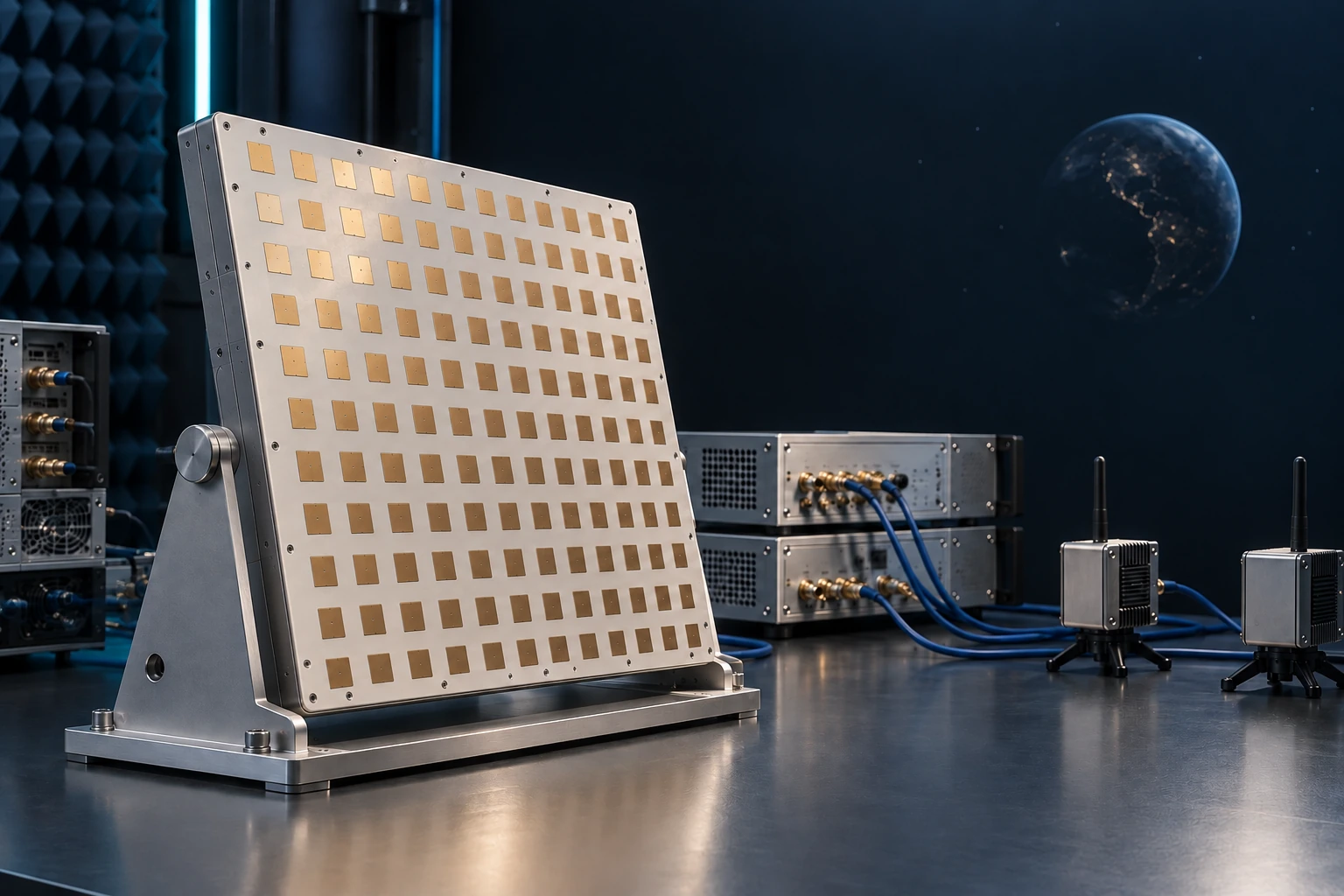
Conceptual laboratory scene showing a direct-radiating array, generic payload processing and separate receiving-terminal paths.
A direct-radiating-array concept beside the conducted payload-to-terminal test chain.
Project focus

SPAICE researches AI-assisted satellite signal processing using commercial chipsets. Its published testbed combines flexible payload configuration, adaptive beamforming for a multibeam direct-radiating array, channel emulation and receiving terminals. The payload forms the signals; the laboratory reconstructs the beams and channel conditions experienced by the terminals.

Testing challenge

What the evaluation
needs to reveal.

A beamforming decision must be evaluated alongside the spatial channel and the received radio signal. Payload demand and pointing inputs change the beam weights, while delay, Doppler and noise change the link. Controlled laboratory cases help distinguish a payload decision from the channel effects seen by each receiving terminal.

Emulator contribution

Reconstructing the link and received beams.

An earlier ELARA version, named ChEM in the 2024 paper, applies delay, Doppler and noise and reconstructs the beam signals received by the terminals. This spatial-channel role sits between the AI-assisted payload and the receiving user equipment. The paper presents a laboratory testbed; its preliminary payload results are separate from current ELARA product performance.

Evaluation focusConditions. Observations. Engineering questions.A way to frame the evaluation.
ConditionObservationEngineering question
Payload beam weights and spatial-channel caseReceived beam signals and endpoint responseHow do the payload weights and channel case affect each receiving terminal?
Delay, Doppler and noise around the payload signalsTerminal synchronisation and useful trafficWhich change follows the channel rather than the payload decision?
Traffic demand and pointing inputsPayload configuration alongside terminal trafficDoes the payload adaptation serve the intended beam under the chosen link conditions?

Partners and funding

ESA research funding for the University of Luxembourg’s SPAICE project.

Project roles

University of Luxembourg / SnT
Research host.
SIGCOM
Research group.
ESA
Research funder.
Project sources